



Animation and Performance in "Nobles": Emotion, Lip Sync, and Humanoid Motion

Updated: Jun 12
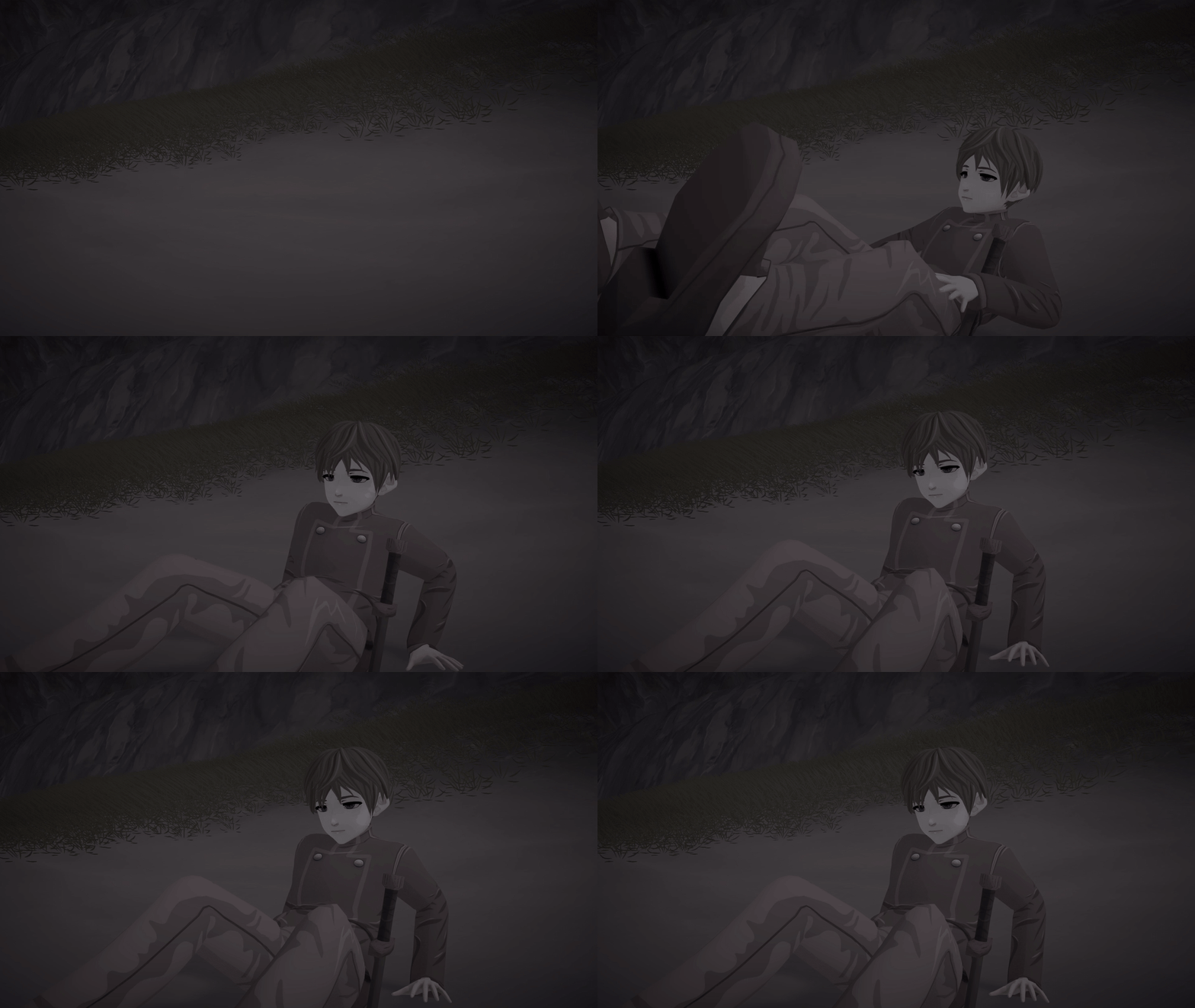
Why animation is more than simply movement...
Players do not only read dialogue. They read bodies. They notice posture, hesitation, acceleration, impact, anticipation, and reaction. That is why animation is one of the most important bridges between concept and feeling. In a story-driven action RPG like Nobles, animation is not just a way to move models. It is one of the main ways characters take on personality and come to life.
Principles of animation and readable action...
The foundational principles of animation remain useful even in modern game pipelines because they describe how motion gains clarity and force. Ideas such as anticipation, timing, spacing, follow-through, overlap, arcs, exaggeration, and solid posing all help movement feel intentional rather than robotic. Anticipation prepares the eye for action. Timing determines whether a move feels heavy, quick, emotional, or comedic. Follow-through and overlap prevent motion from feeling abruptly mechanical. Strong poses make the purpose of an action readable at a glance.
These concepts matter in gameplay and cutscenes alike. A sword swing needs readable anticipation so the player and the opponent can understand its threat. A reaction animation needs timing that communicates pain, surprise, or resolve. A subtle head turn or pause before speech can make a cutscene feel much more alive. Animation principles are not old-fashioned rules; they are tools for readable expressions that are universal.

Basic emotions in actor performance...
Emotion is the next major layer. Much performance theory returns to a small set of basic emotions—anger, fear, sadness, joy, disgust, surprise, and contempt or related variations—not because human feeling is simple, but because these core categories produce recognizable signals in the face and body. For a stylized game, this is especially helpful. Anime-inspired presentation often depends on emotional legibility. The audience should be able to sense conviction, worry, frustration, grief, or relief quickly and clearly.
That does not mean every emotion should be exaggerated. The better lesson is that emotion must be designed. A guarded character may minimize movement and eye contact. A defiant character may hold tension in the chest and stance. A grieving character may collapse inward or delay reaction. These choices matter because human beings instinctively read physical behavior as part of character.

Lip sync and spoken believability...
Adequate lip sync adds another level of believability. The purpose of lip sync is not simply matching mouth shapes in a literal way. It is making speech feel embodied. Good lip sync depends on timing, phoneme selection, expression, and the relation between jaw movement and the emotional tone of the line. Speech that is mechanically synchronized but emotionally dead still feels weak. Speech that supports the line’s intention—hesitation, anger, calm, fear—feels much more convincing. We want to be convinced.
In a project like "Nobles", this is paramount because the scenes carry dramatic dialogue, vows, warnings, conflicts, and character-defining exchanges. If the facial performance and mouth movement feel detached from the spoken words, the scene loses force. But when lip sync supports expression rather than replacing it, the result feels much stronger.

Humanoid animation and retargeting in Unity
Unity’s humanoid animation system, often discussed through Mecanim, is useful here because it allows a structured approach to character motion. Rigging characters to humanoid standards can support retargeting, reuse, and consistent animation workflows across multiple characters. Animation states, blends, and transitions help connect locomotion, combat, reaction, and cinematic behavior. Instead of treating every animation as isolated, the game can organize movement into a coherent state-driven system.
Animation supports both cutscenes and gameplay!
That matters not only for production efficiency, but for continuity of character. A player should feel that the same hero exists in movement, combat, and story scenes. If gameplay animation feels disconnected from cinematic animation, the character splits in two. A strong pipeline tries to preserve identity across both modes. The same person who fights should also emote believably in a cutscene.
This is one reason I think animation is at the center of "Nobles". The game’s identity depends on both action and drama. Action needs responsiveness and readable motion. Drama needs expression and performance. Animation is where those needs meet. It carries sword strikes, traversal, idle presence, emotional reactions, and dialogue beats. It gives the player a body to believe in.
Applying the concept to "Nobles"...
There is an important production lesson here. Strong animation begins long before final polish. It depends on clear character intent, strong posing, emotional planning, and a workable implementation pipeline. It also depends on knowing when to stylize. Nobles does not need to imitate realism at all costs. A medieval fantasy anime RPG can benefit from slightly heightened poses, clearer silhouettes, and expressive emphasis, as long as the motion remains readable and true to the tone of the game.
In the end, animation is one of the main ways a game proves that its characters exist in time rather than only in concept art. A design sketch can suggest identity. A model can suggest form. But motion reveals thought, feeling, and will. That is why animation deserves to be treated as storytelling, not just technical support.
For "Nobles", emotion, lip sync, and humanoid motion are all part of the same goal: making characters feel present. When a player believes in the body, they are more likely to believe in the scene, the world, and the journey itself. There is an extension of one system of belief.


%20(1960%20x%20240).jpg)
Comments