



Blocking, Pacing, and Audio in "Nobles": How a Scene Takes Shape

Updated: Jun 12

Blocking as storytelling through position and movement...
Once the visual idea of a scene is established, the next challenge is making it feel "alive" or "authentic". A scene may have good dialogue and strong framing but still feel flat if the characters are staged weakly, if the rhythm does not build, or if the audio fails to support the dramatic turn. That is where blocking, pacing, score, and sound design become crucial.
Blocking is often described as the placement and movement of characters within a scene, but that definition is a little too narrow. Blocking is really about relationships made visible. Who controls the space? Who closes distance? Who withdraws? Who interrupts the frame? Who remains still while others move? These questions are dramatically meaningful. A confrontation feels different when one character invades another’s space. A farewell feels different when a person turns away before speaking. Even silence becomes expressive when bodies are arranged with intention.
In "Nobles", this matters because fantasy drama often depends on status, tension, and power. A king, lord, mentor, enemy, or companion should not simply occupy space randomly. The way each figure stands, advances, or yields can show rank, fear, challenge, grief, or loyalty before the dialogue spells anything out. Good blocking is one of the fastest ways to make a scene feel authored or intentional.
Camera movement as narrative emphasis...
Camera movement extends that language. A scene may begin in a stable composition and then shift as emotion changes. A gentle push-in can intensify intimacy or dread. A tracking move can reveal space and relationship. A sudden reframing can mark the arrival of threat or revelation. The key lesson is that movement should be motivated. When cameras move without narrative purpose, the scene starts to feel ornamental. When they move with intention, they guide emotion.
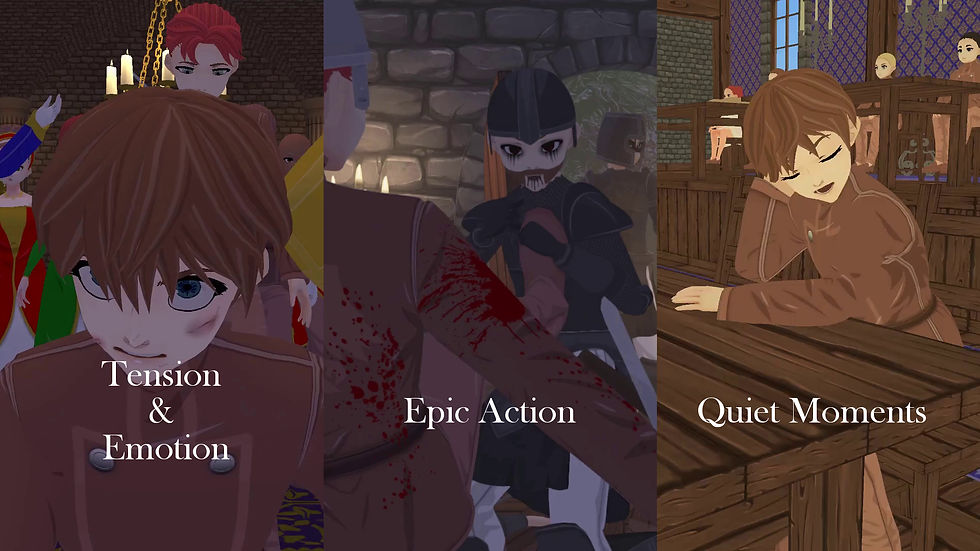
Pacing as rhythm rather than speed...
Pacing is the broader rhythm that holds those decisions together. Good pacing is not simply fast editing or constant action. It is the control of speed and emphasis, so the audience feels tension, release, escalation, and contrast at the right moments. A cutscene can be slow and still be gripping if the emotional pressure keeps increasing. It can be fast and still feel empty if every beat is given the same weight.
This is important in game storytelling because cutscenes sit beside interactive play. If a scene drags, the player becomes impatient. If it rushes through all its turns, the moment loses impact. The best pacing usually comes from variation. A held pause can make a line of dialogue land harder. A delayed response can reveal uncertainty. A fast interruption can energize conflict. Rhythm should serve meaning.
What score contributes to emotional meaning...
Audio is one of the strongest tools for shaping that meaning. Score can unify a scene emotionally in ways that visuals alone often cannot. Music can signal danger before the threat is fully understood. It can turn a simple departure into a moment of destiny. It can soften a scene into reflection or sharpen it into tragic momentum. A strong score does not merely decorate emotion; it helps organize the way the audience feels time.
For a project like "Nobles", score can also reinforce identity. Medieval fantasy and anime drama both thrive on musical shaping. Noble themes, tension motifs, sorrowful textures, and rising heroic cues can make the world feel emotionally coherent. The player begins to associate certain musical ideas with characters, danger, sacrifice, mystery, or triumph. That continuity gives the game memory.

Sound design contributes to realism
Sound design works at a different but equally important level. If score provides emotional architecture, sound design provides physical and sensory credibility. Ambience gives a place atmosphere. Footsteps, cloth movement, weapon handling, environmental creaks, room tone, wind, and distant life all make a scene feel grounded. Impact sounds give action consequence. Silence, when used deliberately, can be as powerful as noise.
One of the best lessons from practical sound work is to build a scene in passes. First identify what is missing. Then add ambience, key effects, and transitional sounds. Then refine repetition and balance. This method is useful for games because scenes often feel visually complete before they feel sonically complete. Audio fills the invisible half of the world.
How these layers work together in a scene...
What makes these disciplines exciting is how strongly they depend on each other. Blocking shapes where attention goes. Camera movement reveals or hides information. Pacing determines when the player receives that information. Score colors the emotional meaning of the turn. Sound design makes the scene tangible. Together they create dramatic weight where there would be none otherwise.
In "Nobles", this integrated approach can make cutscenes feel connected to the larger experience. A warning in a stone corridor should not only be heard as dialogue. It should be staged through distance and power, paced through pauses and interruption, scored for tension, and textured with environmental sound. A vow before battle should not only be spoken. It should be built through posture, framing, breathing room, and musical lift. A scene gains weight when all its layers agree with each other and are not absent.
Final remarks...
That is the deeper lesson here. Storytelling in games is not carried by text alone. It is carried by motion, rhythm, sound, and space. Blocking, pacing, score, and sound design turn abstract narrative intent into something the player can feel immediately.
For an independent studio, that understanding is especially useful because it helps prioritize what truly strengthens a scene. Not every cutscene needs scale or every story a wealth of scenes. But every strong cutscene needs intention. In "Nobles", these tools are part of what turns a sequence from information delivery into drama.


%20(1960%20x%20240).jpg)
Comments